Securing Smart Meters: Lessons from Cyber-Physical Systems
When I embarked on my MSc in Cyber Security Engineering, I didn’t expect to find myself knee-deep in smart meters, Advanced Metering Infrastructure (AMI), and operational technology (OT) security. But here we are, one coursework and countless security assessments later, I developed a framework to secure AMI networks and smart meters from cyber threats. Here’s how it went down.
AMI and Smart Meters: A Double-Edged Sword
Smart meters and AMI networks are the backbone of modern utility infrastructure, offering real-time consumption monitoring, remote diagnostics, and automated billing. But like all great tech, they come with security risks: spoofing, data manipulation, and denial-of-service attacks, to name a few.
The Security Challenges
I dissected AMI’s security risks using the STRIDE threat modeling framework:
- Spoofing: Fake smart meters injecting false data
- Tampering: Physical attacks to alter readings
- Repudiation: Lack of audit trails for device actions
- Information Disclosure: Unencrypted transmissions revealing usage data
- Denial of Service: Flooding attacks disrupting network operations
- Elevation of Privilege: Weak authentication enabling unauthorized access
👉 Lesson learned: AMI networks need layered security, from device hardening to network segmentation.
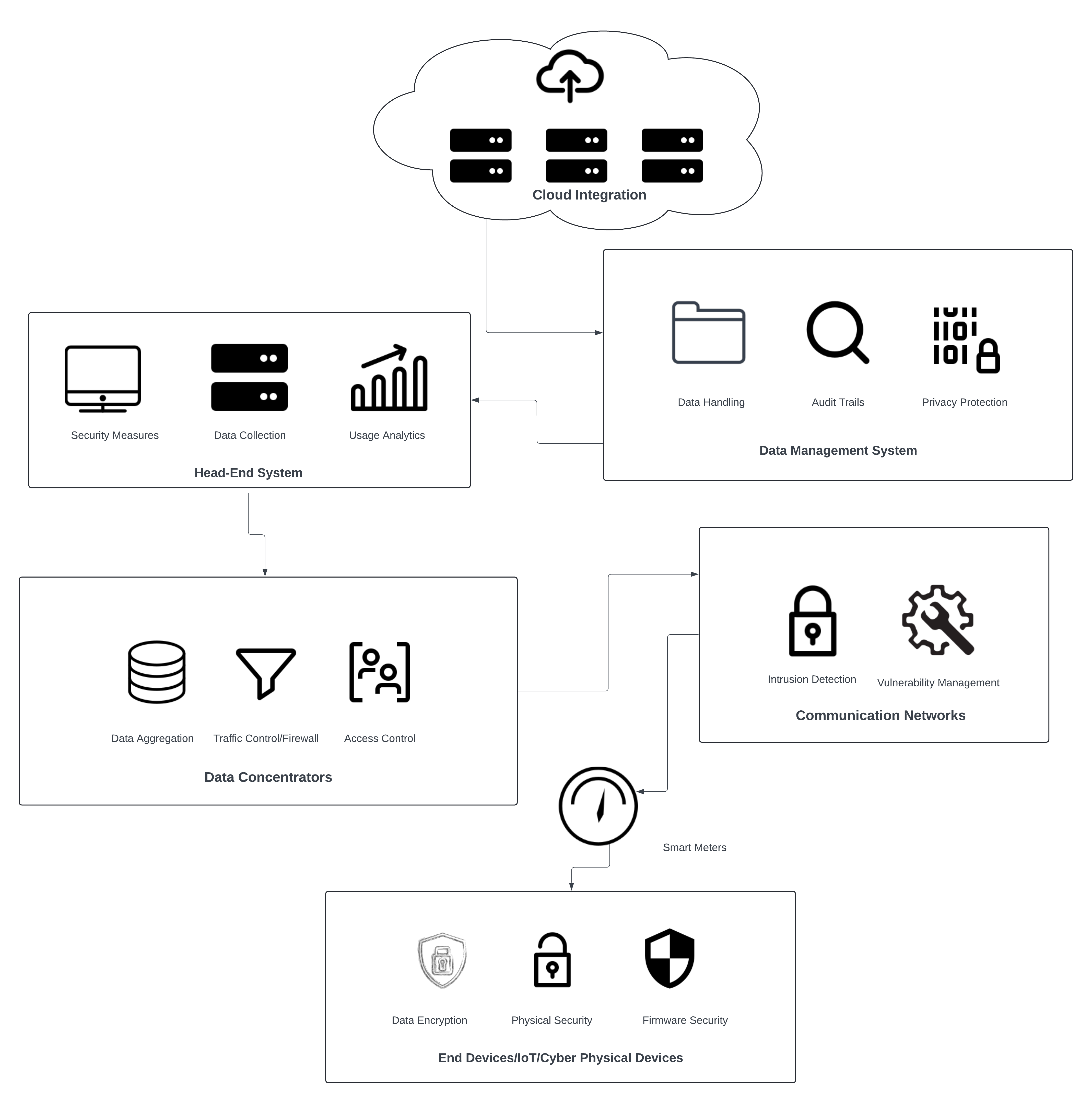
Architecting Security: Network Segmentation & Firewalls
One major win from my coursework was designing a secure AMI network architecture. Key strategies:
- Segmentation: Isolating smart meters, data concentrators, and head-end systems to limit attack spread.
- Firewalls: Configuring filters at data concentrators and head-end systems.
- Encryption: Securing data in transit with AES-256 and TLS.
- Role-Based Access Control (RBAC): Ensuring the right people access the right systems.
AMI Network Security Architecture
👉 Lesson learned: A flat network is a hacker’s paradise: segmentation is king.
Intrusion Detection & Response: Snort to the Rescue
To detect anomalies, I implemented Intrusion Detection Systems (IDS) using Snort. One Snort rule I wrote monitored for excessive connection attempts on MQTT (a common AMI protocol):
alert tcp any any -> $MQTT_BROKER_IP 1883 \
(msg:"MQTT Excessive Connection Attempts"; flow:to_server,established; \
threshold:type threshold, track by_src, count 10, seconds 60; sid:1000002; rev:1;)
👉 Lesson learned: Detect early, respond faster. IDS combined with a solid Incident Response Plan (IRP) is a game-changer.
Cloud Security Considerations
Modern AMI systems leverage cloud computing for scalability. That means:
- Identity and Access Management (IAM) for secure API interactions
- SIEM integration for centralized monitoring
- Data anonymization to protect customer privacy
👉 Lesson learned: Security doesn’t stop at the network, cloud security is crucial.
Final Thoughts
This coursework wasn’t just an assignment, it was a deep dive into Operational Technology (OT) security and how critical infrastructure needs robust defense mechanisms. The next time you see a smart meter, remember: it’s more than just a digital power counter; it’s a cybersecurity battleground.